

 Română

| (July 24, 1939 Hmelnitki, Ukraine)
Physician, scientific area: quantum chemistry and solid state physics.
|
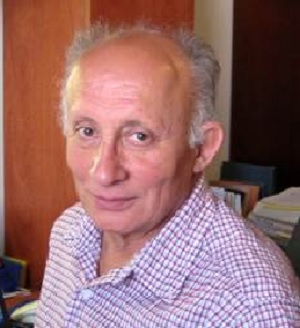 |
After graduating from the Faculty of Physics and Mathematics of Chișinău State University in 1961, Boris Tsukerblat worked as a physics teacher at the secondary school in Palanca, Ștefan Vodă District (1961–1964). He subsequently joined the Institute of Chemistry, where he served as Laboratory Assistant, Junior Researcher, Senior Researcher, and Principal Researcher in the Laboratory of Bioinorganic Chemistry (currently the Laboratory of Bioinorganic Chemistry and Nanocomposites) from 1965 to 1999. From 1999 to 2002, he was Principal Researcher at the Institute of Applied Physics of the Academy of Sciences of Moldova. Since 2002, he has been a Professor in the Department of Chemistry at Ben-Gurion University of the Negev, Beer-Sheva, Israel.
His PhD dissertation, entitled “Multiphonon Processes in Impurity Centers of Crystals”, prepared under the supervision of Professor Yurii E. Perlin, was defended in 1967 at Kazan State University (USSR). His Doctor Habilitatus dissertation, entitled “Vibronic and Exchange Interactions in Doped Crystals”, was defended in 1975 at the University of Tartu (Estonian SSR).
The scientific interests of Corresponding Member Boris Tsukerblat include:
- Molecular magnetism and molecular magnets;
- Vibronic interactions and the Jahn–Teller effect in molecules and crystals;
- Spectroscopy of transition metal complexes and impurity centers in doped crystals;
- Group theory applied to molecular magnetism and the Jahn–Teller effect, including computational approaches.
In his scientific research, Professor Tsukerblat proposed and developed the small-radius impurity center model for dielectric and semiconductor crystals, including detailed studies of the dynamic Jahn–Teller effect and crystal-field interactions in the partially filled electron shells of transition-metal and rare-earth ions. He developed the theory of non-radiative multiphonon transitions, electron-vibrational optical band shapes, and polarization dichroism effects in Jahn–Teller centers, providing a theoretical basis for calculating key parameters of doped laser crystals. He also proposed a novel approach to the analysis of exchange interactions in multi-electron systems based on higher symmetry theory and irreducible tensor operators.
Professor Tsukerblat further developed the theory of magnetic susceptibility, nuclear magnetic resonance, and inelastic neutron scattering in transition-metal magnetic clusters. He formulated the theory of exchange interactions in transition-metal exchange clusters with degenerate electronic shells, where the conventional Heisenberg Hamiltonian becomes inadequate, and explained the anomalously strong magnetic anisotropy associated with the orbital motion of electrons. He introduced a new theoretical treatment for analyzing the energy spectra and thermodynamic properties of mixed-valence polynuclear clusters by simultaneously accounting for double exchange and vibronic interactions. His research also explained the diamagnetism of fullerenes and polyoxometalate compounds, as well as the magnetic properties of biologically important metal clusters. He predicted and investigated charge and structural ordering in mixed-valence molecular crystals, discovered the coexistence of localized and delocalized electronic states, clarified the physical origin of long-lived states in iron complexes, and developed the vibronic model of the photochromic effect.
Corresponding Member Boris Tsukerblat is the author of more than 380 scientific publications in leading international journals, including 15 review articles and four monographs:
- B.S. Tsukerblat, Group Theory in Chemistry and Spectroscopy, Dover Publications, Mineola, New York, pp. 1–448 (2006).
- B.S. Tsukerblat, Group Theory in Chemistry and Spectroscopy: A Simple Guide to Advanced Usage, Academic Press, London, pp. 1–438 (1994).
- Yu.E. Perlin, B.S. Tsukerblat, Effects of Vibronic Interactions in the Optical Spectra of Paramagnetic Impurity Ions, Academy of Sciences Publishing House, Chișinău, pp. 1–368 (1974) (in Russian).
- B.S. Tsukerblat, M.I. Belinskii, Magnetochemistry and Radiospectroscopy of Exchange Clusters, Academy of Sciences Publishing House, Chișinău, pp. 1–280 (1983) (in Russian).
Together with his research group, Corresponding Member Boris Tsukerblat established a new research direction in the field of magnetochemistry and spectroscopy of polynuclear coordination compounds. He supervised the successful completion of 26 PhD and Doctor Habilitatus dissertations.
Professor Tsukerblat has served as a Visiting Professor at numerous internationally recognized institutions, including:
- Institute of Low Temperature and Structure Research, Polish Academy of Sciences, Wrocław, Poland (1989);
- Institute of General and Inorganic Chemistry, Bulgarian Academy of Sciences, Sofia, Bulgaria (1990);
- University of Florence, Italy (1990, 1991, 1993, 1994);
- Universities in the United States (1991–2004), including the University of Virginia, Georgia Institute of Technology, Carnegie Mellon University, the University of North Carolina at Chapel Hill, and Texas A&M University;
- Universities in France (1992–1997), including the University of Bordeaux, Université Paris-Sud, and Sorbonne University (formerly Université Pierre et Marie Curie);
- University of Valencia and the Institute of Molecular Science, University of Valencia, Spain (1992–2018).
He serves on the editorial boards of the journals Chemistry Journal of Moldova, Physical Journal of Moldova, Scientific Research and Essays, and Magnetochemistry.
In recognition of his outstanding professional achievements and scientific contributions to laser investigations of the optical properties of crystals, Professor Boris Tsukerblat was awarded the State Prize of the Moldavian SSR in 1987.
References
- Membrii Academiei de Științe a Moldovei: Dicționar (1961-2006). Chișinău: Știința, 2006, 432 p.
- Batîr D. Neliniștea memoriei. Evoluția chimiei în Moldova și avatarurile vieții. Chișinău, 2007, 348 p.
- Academia de Științe a Moldovei. Academicieni și membri corespondenți. Duca Gh. (coord.), Chișinău, 2015, 192 p.
- Vlad, P. Ed. The Institute of Chemistry of the AS MSSR (1959-1984 years). Stiinta: Chisinau, 1987, 145 p. (in Russian)
- Aricu A., Nastas R., Cocu M. The Institute of Chemistry at 60 years anniversary. Brief history, achievements and perspectives. Chemistry Journal of Moldova, 2019, 14(1), p. 8-31. doi: http://dx.doi.org/10.19261/cjm.2019.349
https://www.bgu.ac.il/~tsuker/
https://ro.wikipedia.org/wiki/Boris_%C8%9Aucherblat